What is the problem?
Healthcare interventions are more likely to be effective when they are adapted to the needs, circumstances and cultures of the populations and settings in which they will be used (Bernal and Adames, 2017; Moore et al., 2021). However, interventions are frequently transferred between populations without sufficient consideration of differences in language, cultural beliefs, family roles, communication practices, health literacy or access to healthcare. This can make them less relevant, acceptable or accessible, particularly for people from minority ethnic and underserved communities, and may unintentionally reinforce existing health inequalities.
Cultural adaptation is also sometimes restricted to relatively superficial modifications, such as translating materials or changing images, without considering whether the intervention’s content, delivery and underlying assumptions are culturally meaningful. Furthermore, adaptation processes are frequently underreported or treated as a “black box”, making it difficult to understand what was changed, why decisions were made or how other teams could reproduce the approach (Harper Shehadeh et al., 2016; Heim and Kohrt, 2019).
Whilst frameworks for cultural adaptation exist, researchers and healthcare professionals still lack clear, practical guidance for applying them systematically, transparently and in genuine partnership with communities. This creates a risk that adaptations will be informal, inconsistent or insufficiently responsive to the people they are intended to support.
Why does it need to be addressed now?
The UK population is increasingly diverse, yet persistent inequities remain in people’s access to healthcare, experiences of services and health outcomes. At the same time, interventions developed in one setting are increasingly being implemented across different communities and healthcare systems. There is therefore a need to ensure that interventions are not simply made available to diverse populations but are designed or adapted so that they are meaningful, accessible and appropriate. Without a structured approach, adaptation can be inconsistent, poorly reported or treated as an optional addition rather than an essential part of developing equitable healthcare. Researchers, healthcare professionals, policymakers and service providers need practical tools that help them consider culture and context throughout the adaptation process while preserving the intervention’s important functions.
What difference will it make?
This programme of research has produced an eight-step guide for Cultural Adaptation of Healthcare Interventions. The guide provides a structured process for culturally adapting healthcare interventions in partnership with the people and communities who will use them.
The guide supports teams to understand the target population and context, identify potential barriers to engagement, work collaboratively with communities, make evidence-informed adaptations and document how decisions were reached. It encourages teams to look beyond translation and representation and consider deeper issues such as beliefs, trust, relationships, delivery settings, communication and structural inequalities.
The guide is intended to support researchers, healthcare professionals, policymakers, commissioners and organisations developing or implementing interventions. By making cultural adaptation more systematic, transparent and participatory, this work aims to produce interventions that are more relevant, acceptable and accessible to diverse communities, supporting fairer engagement, more effective implementation and improved health equity.
You can download the guide and roadmap here
 Racialised incivilities are subtle, everyday acts of disrespect, exclusion, and hostility which are a common but overlooked experience in NHS maternity services. While the NHS promotes equality, diversity, and inclusion, racially minoritised staff remain unfairly exposed to unprofessional behaviours such as incivility, bullying, harassment and abuse (from multiple sources) that harm their wellbeing, teamwork, and pose a risk to patient safety (Keller et al., 2020; Woodhead et al., 2021). These behaviours are often minimised as personality clashes or communication issues, meaning the racialised nature of harm is rarely recognised or addressed. Current safety frameworks focus on systems and individual error but largely ignore how structural inequity and discrimination shape workplace cultures, behaviours and care quality (Schulson et al., 2022; Maben et al., 2023).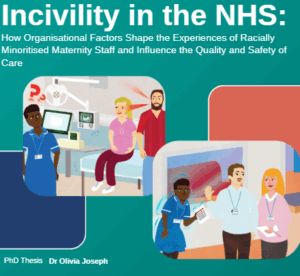

 What is the problem?