Tag

Older People Archives - Yorkshire Quality and Safety Research Group

By Academic Resources, Publications

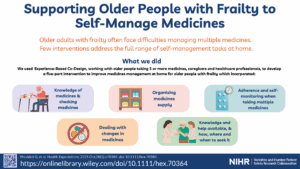
Supporting Older People Living With Frailty to Self-Manage Multiple Medicines: An Experience-Based Co-Design of a Complex Intervention Developed in UK Primary Care

Previdoli, G., Simms-Ellis, R., Silcock, J., Alldred, D.P., Cheong, V.-L., Tyndale-Biscoe, S., Tomlinson, J. and Fylan, B. (2025), Supporting Older People Living With Frailty to Self-Manage Multiple Medicines: An Experience-Based Co-Design of a Complex Intervention Developed in UK Primary Care. Health Expectations, 28: e70364. https://doi.org/10.1111/hex.70364

Read the full paper here

Access the ‘I Manage My Meds’ toolkit here

Making medicines safer for care home residents

By Toolkits, Interventions & Change Strategies

care home staff giving a resident their medicineWhat was the problem?

Care home residents are often prescribed many medicines. Medicines can be beneficial, but taking multiple medications can sometimes cause side effects and affect residents’ quality of life. It’s important that people living in care homes have their medications regularly checked with a healthcare professional to make sure they are still suitable.

What have we done to address this problem?

We worked with residents, relatives, care home staff and healthcare professionals to develop a set of resources so that residents and care home staff can be actively involved in discussions about medicines. They include questions that residents might want to ask, such as “Do I still need all my medicines?” and “How do I know they are helping me?”.

What did we produce and who is this useful for and why? Picture of resources

The resources are designed for healthcare professionals, care home staff and residents and relatives to use when reviewing medicines. They have been launched by the Health Innovation Network in September 2025, and build on the success of resources designed by our group which are used across England for older people living in their own homes.

You can find all of these here.


Your Care Needs You

By Websites

Your Care Needs You! is designed to empower, encourage and support patients and their families to know more and do more in hospital, so that people have the skills and confidence to manage their own health and care more safely when they return home. There are resources to guide patients and families through the key things to do in hospital to prepare for living at home again.

You can find the resources here


Reducing the risk of older people being readmitted into hospital

By Toolkits, Interventions & Change Strategies

What was the problem?

Moving from hospital to home (the ‘transition’) is a risky time for older patients (75+ years). Around 18% of patients end up back in hospital as an emergency. Most of the time, these re-admissions cannot be avoided, but oftentimes they can.

What have we done to address this problem?

We wanted to understand and improve the experience and safety of care for older people as they move from hospital to home to reduce unnecessary hospital re-admissions. To do this, we conducted six pieces of research (called work packages). First, we tried to understand from patients, families and staff how they experienced care transitions. Next, we developed a tool to measure these experiences. We then worked with staff and patients and members of the public to develop an approach (called ‘Your Care Needs You’), to help involve and prepare older people for going home after a hospital stay.

What did we find?

We then ran a trial to find out if people who received ‘Your Care Needs You’ were less likely to go back into hospital. For this, we put ‘Your Care Needs You’ into 18 wards and compared hospital re-admissions there with 21 wards which delivered care as usual. We found that the rate at which patients were re-admitted to hospital was better in the ‘Your Care Needs You’ wards but this was not significantly better. Three months after discharge, the number of people being re-admitted to the hospital was 13% less in the ‘Your Care Needs You’ wards. The approach also reduced the problems that people experienced (such as falls) around 1 month after discharge. We found that many of the wards did not deliver the approach as planned, so not all patients got ‘Your Care Needs You’. This was mainly because of staffing pressures after the COVID-19 pandemic. While some patients found the approach useful, others thought it was not for them. The approach is cheap to deliver and, on balance, is worth the cost.

What did we produce and who is this useful for and why?

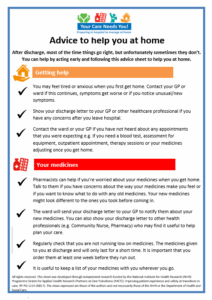
‘Your Care Needs You’ included a booklet, an advice sheet for managing at home, and a film for patients.

You can find all of these here.
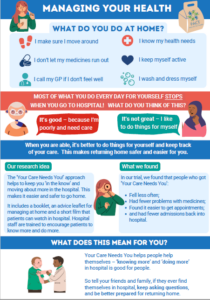
   Advice sheet

By Academic Resources

Improving the safety and experience of transitions from hospital to home: a cluster randomised trial of an intervention to involve older people in their care (Your Care Needs You)

Jenni Murray, Kalpita Baird, Stephen Brealey, Laura Mandefield, Gerry Richardson, Jane O’Hara, Robbie Foy, Laura Sheard, Alison Cracknell, Alfredo Palacios, Simon Walker, Ed Breckin, Lubena Mirza, Ruth Baxter, Catherine Hewitt, Rebecca Lawton, Improving the safety and experience of transitions from hospital to home: a cluster randomised controlled trial of an intervention to involve older people in their care (Your Care Needs You), Age and Ageing, Volume 54, Issue 5, May 2025, afaf142, https://doi.org/10.1093/ageing/afaf142

Read the full paper here