
 What was the problem?
Moving from hospital to home (the ‘transition’) is a risky time for older patients (75+ years). Around 18% of patients end up back in hospital as an emergency. Most of the time, these re-admissions cannot be avoided, but oftentimes they can.
What have we done to address this problem?
We wanted to understand and improve the experience and safety of care for older people as they move from hospital to home to reduce unnecessary hospital re-admissions. To do this, we conducted six pieces of research (called work packages). First, we tried to understand from patients, families and staff how they experienced care transitions. Next, we developed a tool to measure these experiences. We then worked with staff and patients and members of the public to develop an approach (called ‘Your Care Needs You’), to help involve and prepare older people for going home after a hospital stay.
What did we find?
We then ran a trial to find out if people who received ‘Your Care Needs You’ were less likely to go back into hospital. For this, we put ‘Your Care Needs You’ into 18 wards and compared hospital re-admissions there with 21 wards which delivered care as usual. We found that the rate at which patients were re-admitted to hospital was better in the ‘Your Care Needs You’ wards but this was not significantly better. Three months after discharge, the number of people being re-admitted to the hospital was 13% less in the ‘Your Care Needs You’ wards. The approach also reduced the problems that people experienced (such as falls) around 1 month after discharge. We found that many of the wards did not deliver the approach as planned, so not all patients got ‘Your Care Needs You’. This was mainly because of staffing pressures after the COVID-19 pandemic. While some patients found the approach useful, others thought it was not for them. The approach is cheap to deliver and, on balance, is worth the cost.
What did we produce and who is this useful for and why?
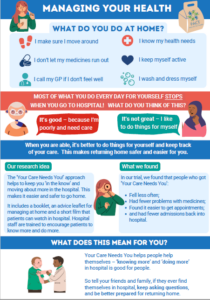
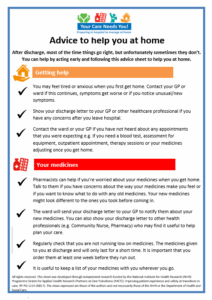
‘Your Care Needs You’ included a booklet, an advice sheet for managing at home, and a film for patients.
You can find all of these here.