You are viewing the webpage for staff working in practices randomised to the Control Arm of the SSNAP feasibility study.
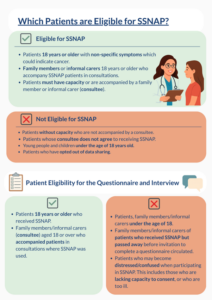
Your practice is taking part in a feasibility study of the Shared Safety Net Action Plan (SSNAP): A safety-netting intervention that aims to engage patients in safety-netting about non-specific symptoms that could be a sign of cancer, to support early diagnosis.
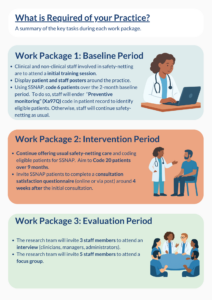
SSNAP records outcomes of safety-netting consultations in SystmOne when patients present with uncertain symptoms. The tool provides patients with an electronic or paper version of SSNAP to support patients in understanding which symptoms to monitor, for how long, and in which circumstances to reconsult. SSNAP also provides ways to follow patients up through scheduled tasks and reminders.
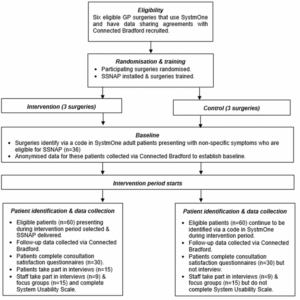
SSNAP will be studied in 6 general practices across Bradford and Airedale. The research aims to assess the feasibility and acceptability of SSNAP to support earlier diagnosis of cancer in general practice, to inform the design of subsequent large cluster RCT.
Three of the participating practices have been randomised into the control arm of the research, with the other three randomised into the intervention arm. Your practice has been randomised into the Control arm of the study.